


ontent Pipelines
Visual drift is the primary enemy of the modern content team. When production is decentralized, and creators are given carte blanche to use various generative platforms, thThe rapid democratization of generative video has created a unique “Day 2” problem for content teams. On Day 1, the excitement of generating a high-fidelity cinematic clip from a text prompt is enough to fuel experimentation. But by Day 2, when a team of five editors tries to produce a unified social campaign using three different AI models, the output often resembles a visual “Frankenstein.” One clip looks like a high-budget A24 film, another looks like a hyper-saturated mobile game ad, and the third suffers from the uncanny valley of mid-2023 physics.
For creative operations leads, the challenge isn’t just about finding the “best” model; it’s about operationalizing these tools so that the output is repeatable, brand-compliant, and scalable. Scaling generative media requires moving away from the “slot machine” approach—where creators prompt repeatedly until they get lucky—toward a structured pipeline that treats AI models as specific lenses within a larger production house.
The Frankenstein Effect in Generative Ce brand’s visual identity begins to fragment. This “Frankenstein Effect” occurs because different underlying architectures (Diffusion vs. Transformers) interpret lighting, skin texture, and motion physics in fundamentally different ways.
If one creator relies on Kling for its fluid character movements while another uses Wan 2.7 for its prompt adherence, the resulting B-roll will feel disjointed when cut together. This isn’t just an aesthetic issue; it’s a brand equity risk. Consistency is the hallmark of professional production. When a viewer sees a sudden shift in the “grain” of the video or the way light bounces off a surface, it signals a lack of intentionality.
To combat this, teams must standardize their toolset. This doesn’t mean limiting creativity; it means establishing a shared environment where the technical variables—such as model versioning and upscale parameters—are constant. Standardizing the environment allows the team to focus on “Style Guides for Prompts,” which define not just what to generate, but the technical constraints (e.g., “35mm lens, golden hour lighting, low motion noise”) that keep the output within a specific brand universe.
Comparative Logic: Matching AI Models to Production Tiers
Not all generative models are created equal, and treating them as interchangeable is a common operational mistake. A sophisticated team builds a “Model Hierarchy” based on the specific needs of a campaign.
For instance, Kling has emerged as a powerhouse for complex human motion. If the project requires a character performing a specific, fluid action—like pouring a glass of water or walking through a crowded street—Kling’s physics engine generally outperforms its peers. However, it can sometimes lean into a “dreamlike” smoothness that might not fit a gritty, documentary-style brand.
In contrast, Wan 2.7 often shows superior adherence to complex, multi-subject prompts. When the creative direction requires a specific arrangement of objects in a room, Wan 2.7 is less likely to “hallucinate” the layout. Then there is Seedance 2.0, which many teams now deploy specifically for cinematic textures. It excels at environmental shots and high-dynamic-range lighting, making it the preferred “lens” for establishing shots and atmospheric B-roll.
By categorizing models this way, teams can assign specific tools to specific tasks. A high-motion TikTok sequence might use HappyHorse for its aggressive kinetic energy, while a professional LinkedIn brand film might stick to the more restrained, high-resolution outputs of Seedance or Google Veo.
Operationalizing Consistency with Video-to-Video Workflows
The most significant shift in professional AI video production is the move away from Text-to-Video (T2V) as the primary generation method. T2V is inherently chaotic; the AI has too much “creative freedom,” which leads to consistency issues. To lock in brand physics and composition, teams are increasingly adopting Video-to-Video (V2V) and Style Transfer workflows.
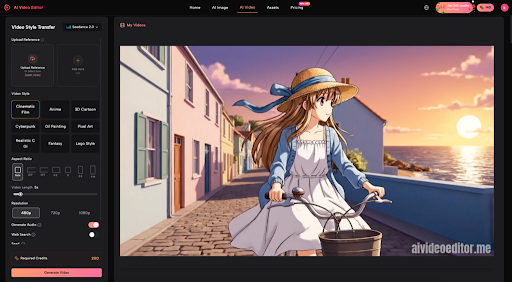
By using AI Video Editor to perform Style Transfer, a team can take disparate pieces of footage—some shot on an iPhone, some sourced from stock libraries—and apply a uniform aesthetic layer. This ensures that regardless of the source, the final output shares the same color grade, texture, and “vibe.”
Using a professional Video Editor AI toolset allows editors to maintain the underlying structure of a shot while changing the stylistic execution. For example, a team can film a basic “mock-up” of a scene in their office and use Video-to-Video AI to transform it into a cyberpunk cityscape. Because the “bones” of the video (the camera movement and character positioning) are real, the AI-generated overlay feels grounded and consistent across multiple shots. This “locked-in” composition is the only reliable way to ensure that a character’s proportions and the scene’s perspective don’t drift between cuts.
The Sandbox Problem: Managing Team Creative Play
Generative AI is a “credit-heavy” endeavor. Without centralized management, teams can quickly burn through production budgets on “discovery” prompts that never make it to the final cut. The solution is to centralize access to multiple models—like Flux, Google Veo, and Grok—within a single interface. This reduces administrative overhead and prevents “tool fatigue,” where creators spend more time managing logins than making content.
Operational consistency also requires a formal peer-review stage for generative clips. It is tempting to Edit Videos Online and push them straight to social media, but generative assets require a specific type of quality assurance. Artifacts—like a sixth finger appearing for three frames or a background object morphing into something else—can easily be missed by the creator who has been staring at the screen for four hours. A “Human-in-the-loop” requirement ensures that every generative clip passes a technical check for temporal coherence before it hits the timeline.
The Limits of Autonomy: What AI Still Cannot Bridge
While the progress in generative video is staggering, it is vital to acknowledge the current technical “ceilings.” We are not yet at the stage of “one-click” commercial production.
First, character and logo consistency remains an unsolved problem for pure generative workflows. If your brand relies on a specific mascot or a very precise logo placement, current models will likely struggle to maintain that identity across different angles and lighting conditions. In these cases, AI is best used for the background and environment, while the brand-critical elements are added back in during traditional post-production or through meticulously trained LoRA models (Low-Rank Adaptation).
Second, there is the issue of temporal coherence in long-form content. Most generative models currently peak at 5-10 seconds of high-quality motion. Attempting to generate a 60-second continuous shot often results in “melting” or a loss of physics as the model loses track of the initial frame’s data. For now, generative tools are best viewed as an asset generation engine—producing the perfect 5-second B-roll clips that an editor then weaves together in a traditional non-linear editor.
Transitioning from Tool-Testing to Production Systems
The honeymoon phase of “look what the AI can do” is ending. For content teams, the next phase is a cold-eyed audit of existing workflows to see where generative clips can replace high-cost stock or complex motion graphics.
This transition requires a shift in identity. Creators are moving from being “prompt engineers”—a term that already feels dated—to being “generative directors.” A director doesn’t just ask for a “cool shot”; they understand the strengths of their actors, the limitations of their gear, and the necessity of a unified vision.
By centralizing diverse models into a single pipeline and focusing on Video-to-Video workflows to anchor consistency, teams can finally scale their output without diluting their brand. The goal of AI Video Editor is no longer just to generate a video; it’s to build a repeatable system where the AI serves the story, rather than the story being a byproduct of what the AI happened to generate that day.
